
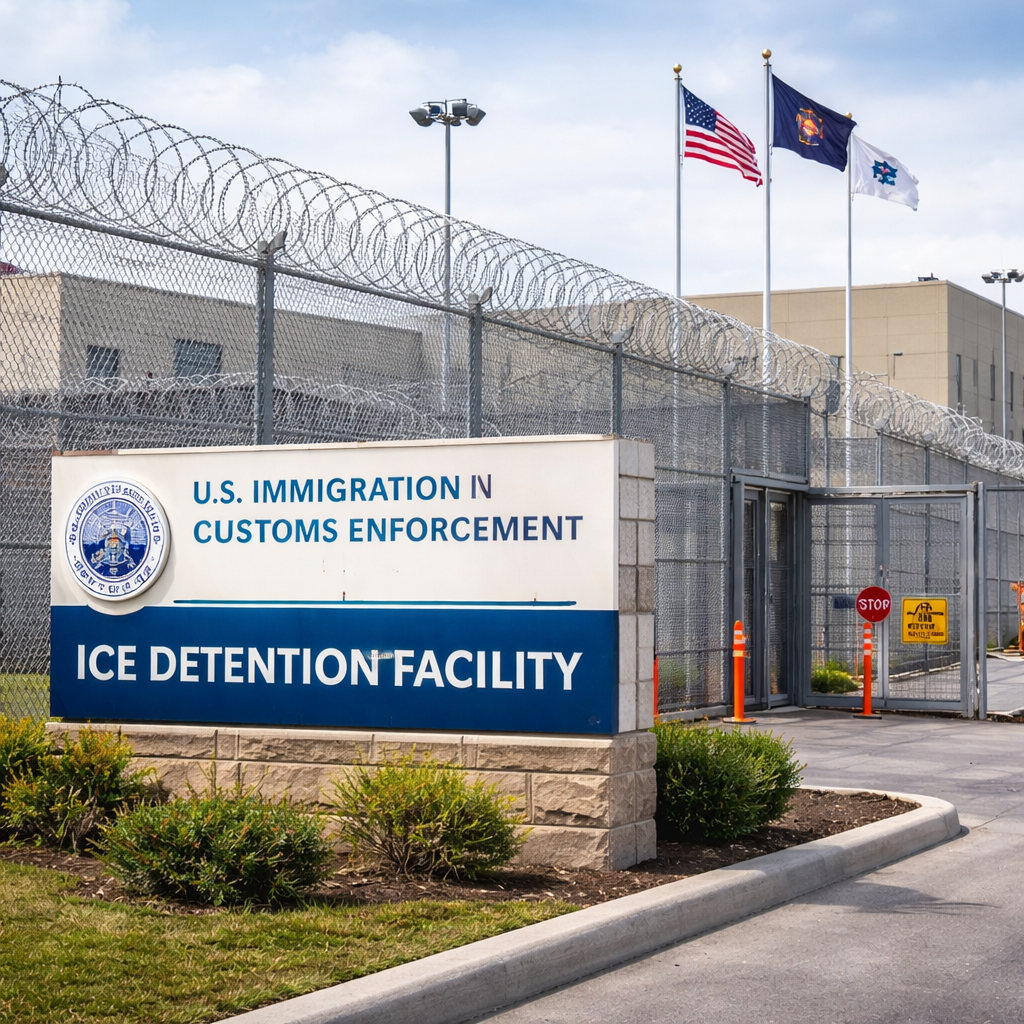
Federal judges in Michigan have ruled that hundreds of immigrants held at a large immigration detention center were likely detained unlawfully, sparking a surge of legal challenges and intensifying a growing legal battle over the Trump administration’s immigration enforcement strategy.
More than 800 habeas corpus petitions have now been filed in federal courts across Michigan. Most of the cases come from immigrants detained at the North Lake Processing Center, a privately operated immigration facility located in northern Michigan.
Habeas corpus petitions allow detainees to ask a federal judge to determine whether their detention violates constitutional protections. In many of the Michigan cases, judges have sided with the immigrants, ordering the federal government to either provide a bond hearing within days or release them.
Stay sharp with The Oceanic Press Brief — your quick, no-fluff snapshot of what’s happening across Australia, New Zealand, and the Pacific. Sign up now to stay informed.
The rulings stem largely from legal disputes over a policy shift introduced last year that dramatically expanded mandatory detention for immigrants without legal status.
In one notable ruling issued in August, Eastern District Judge Brandy R. McMillion criticized the federal government’s interpretation of the law.
“the recent shift to use the mandatory detention framework … is not only wrong but also fundamentally unfair.”
That language has since been cited repeatedly by other federal judges when granting similar petitions.
The wave of legal challenges emerged after the North Lake Processing Center reopened last summer as part of a large-scale deportation push. Thousands of people have passed through the facility since it began holding immigration detainees again.
As the population at the Baldwin, Michigan center climbed toward 1,000 people last fall, federal courts began seeing a sharp rise in legal petitions challenging the detentions.
Before 2025, such cases were rare in Michigan. For years, federal courts in the state saw only a handful of immigration-related habeas filings each month.
That has changed dramatically.
“I had never had to file these in immigration detention cases in my 20-plus years practicing law,” said Grand Rapids-based attorney Robert Alvarez. “In the last few months since we started filing these, we have now filed about five dozen petitions.”
Many of the petitions are being filed without traditional legal funding. Some attorneys say they are handling cases at reduced cost to help detainees challenge their detention.
The dispute centers on how immigration law should apply to people already living inside the United States.
In July, the Department of Homeland Security issued new instructions directing immigration agents that people who entered the country illegally could be subject to mandatory detention and would not be eligible for bond hearings while their deportation cases proceed.
The federal government has long applied strict detention rules to people attempting to enter the country at the border.
However, legal experts say immigrants already living inside the United States have historically been entitled to constitutional due process protections, including the right to seek bond while their cases move through the immigration system.
Andrew Moore, a law professor at the University of Detroit Mercy, said the legal dispute centers on whether those protections still apply under the new interpretation.
“And the question essentially is,” he said, “do you treat those people the same way you treat somebody who’s just arriving and at the border?”
Federal judges in Michigan have repeatedly answered that question by rejecting the administration’s interpretation.
In one of the early cases, the court ordered the release of Juan Manuel Lopez-Campos, a 46-year-old father of five U.S. citizen children, who had been detained for nearly two months.
Lopez-Campos had been stopped by police during a traffic stop and later transferred to immigration authorities.
“The Romulus Police Department pulled him over ‘for allegedly passing a vehicle improperly,’” McMillion said.
Lopez-Campos had no criminal history, a situation attorneys say is common among many detainees filing petitions.
Miriam Aukerman of the ACLU represented Lopez-Campos and sharply criticized the federal government’s expanded detention approach.
“It’s going to result in the needless detention of probably millions of people,” she said.
The government has appealed the case to the U.S. Court of Appeals for the Sixth Circuit.
Officials from federal agencies have defended the policy and criticized the judges issuing rulings against the administration.
In written statements, federal officials described judges who grant the petitions as “rogue” and “activists.”
“After four years of de facto amnesty under the previous administration, the Trump Administration is complying with court orders and fully enforcing federal immigration law,” a spokesperson said. “If rogue judges followed the law in adjudicating cases and respected the Government’s obligation to properly prepare cases, there wouldn’t be an ‘overwhelming’ habeas caseload or concern over DHS following orders,” the statement said in part.
Despite those claims, legal data reviewed by reporters suggests political affiliation has not influenced how judges rule on the petitions.
The legal battle could eventually reach the U.S. Supreme Court.
A federal appeals court covering Texas, Louisiana, and Mississippi recently ruled in favor of the administration’s interpretation, saying detention without bond can be lawful. However, that ruling does not apply to cases in Michigan or other jurisdictions outside that circuit.
Meanwhile, attorneys representing detainees continue to file new petitions.
Amy Maldonado, an immigration lawyer based in East Lansing, said she has represented more than 30 people in similar cases.
“The government is just trying to strip due process and create this deportation machine where nobody has any rights,” she said.
Even when detainees win their cases, freedom is not guaranteed.
Judges may still deny bond if they determine a detainee could be a flight risk.
Court records show that while many people are released after their petitions succeed, others remain detained after immigration judges deny bond.
Maldonado said she has seen a noticeable shift in how bond decisions are being handled.
“There’s information circulating through the private bar for immigration attorneys that immigration judges have been instructed verbally … to find a basis to deny bond based on flight risk,” she said. “And since that time, all of the habeas petitions I have won have been denied [bond] based on flight risk.”
Government officials strongly rejected those allegations.
“Those allegations are unprofessional at best and unethical at worst, as it impugns the integrity of judges with no basis in fact,” a spokesperson said.
For some detainees, the legal process has provided little relief.
Dalveilys Pineda, a Venezuelan asylum seeker who arrived in the United States in 2023 with her husband and young daughter, remains held at the North Lake facility despite winning her habeas case earlier this year.
Pineda had been working as a grocery delivery driver when immigration officers arrested her in a parking lot.
She said she was shocked when an immigration judge later denied her request for bond.
“I don’t understand why because I have never been charged with a crime, and there’s nothing on my record,” Pineda said. “The judge said it was because of the number of family members I have [in the U.S.], but it just felt like an excuse to keep me here.”
As legal challenges continue to mount and appeals move forward, the dispute over immigration detention policies is expected to escalate in federal courts and could ultimately be decided by the nation’s highest court.
Discover more from The Oceanic Press
Subscribe to get the latest posts sent to your email.