
10 Genuinely Weird Facts About Palmerston North
Palmerston North has long been the punchline of New Zealand city jokes. It is flat. It is windy. It sits on a floodplain. A British comedian once publicly mocked it.
But if you actually look at the place properly, it becomes clear that Palmerston North is not boring. It is unusual. Historically layered. Occasionally petty. Quietly influential.
And sometimes deeply weird.
Here are ten properly researched, genuinely strange facts about Palmerston North, ranked from 10 down to 1.
10. It Was Built On A Floodplain That Used To Be Mostly Swamp
Before it became a city, the area around Palmerston North was dense bush and swampy lowland shaped by the Manawatū River. Early European settlers in the 1860s had to drain land, clear forest and construct stopbanks to make large-scale settlement viable.
The city’s extreme flatness today is not an accident. It is the result of building on what was once shifting river territory. Much of modern Palmerston North sits on land that historically flooded regularly.
That geography still defines the city’s character — wide horizons, open skies, and an ever-present awareness of the river.
9. It Once Had Five Lagoons. Only One Survived
Early maps show that the settlement area contained five separate lagoons created by bends in the Manawatū River. As the city expanded, most were drained or filled for development.
Only Hokowhitu Lagoon remains.
What looks like a decorative suburban feature is actually the last visible remnant of a wetter, more unstable natural landscape. It is a geological leftover from when the river carved aggressively through the plains.
8. That Lagoon Is Actually An Abandoned River Bend
Hokowhitu Lagoon is technically an oxbow lake. At some point, the Manawatū River shifted course and cut off one of its loops, leaving a crescent-shaped waterbody behind.
So when people jog around the lagoon, they are circling a former river channel. It is a physical record of how dynamic and unpredictable the region once was.
For a city often described as static or flat, its underlying geology tells a different story.
7. Its Most Famous Landmark Is A Recycled Earthquake Survivor
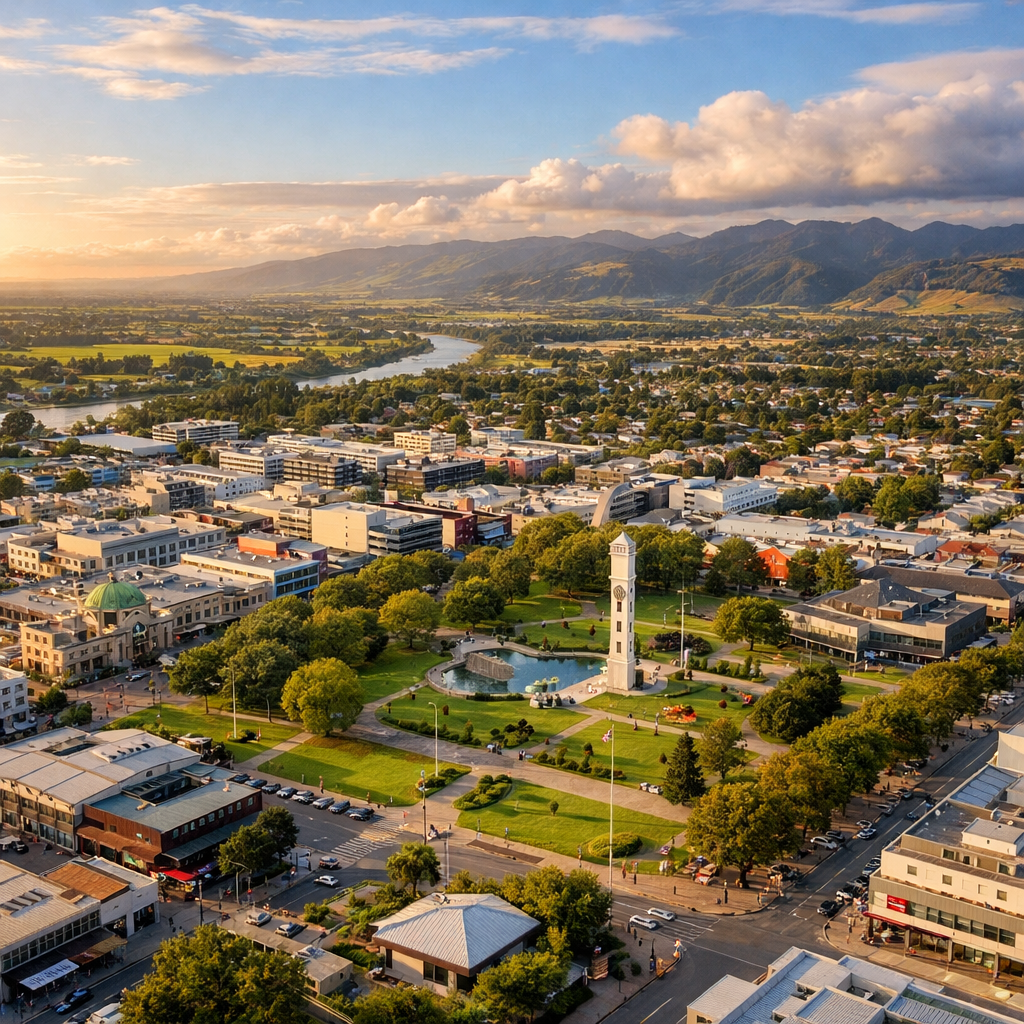
The Hopwood Clock Tower in The Square is one of Palmerston North’s defining landmarks. But the clock mechanism predates the tower.
It originally sat in the city’s Post Office tower. After the 1942 Wairarapa earthquake raised structural concerns, the building was demolished and the clock removed.
For years it sat in storage before local businessman Arthur Hopwood funded the construction of a new tower to house it.
The city’s most recognisable feature is effectively a relocated, rescued relic.
6. The CBD Is Designed Around A Giant 17-Hectare Park
Unlike most New Zealand cities, Palmerston North built its CBD around an enormous central green space called The Square.
The Square covers about 17 hectares. Streets radiate outward from it in a wheel-like layout. Civic buildings, cafés and offices face inward toward trees and lawns rather than forming a tight commercial grid.
It is an unusual piece of urban design that gives the city a strange sense of openness right in the middle of downtown.
5. It Is Home To The World’s First Museum Dedicated Entirely To Rugby
The New Zealand Rugby Museum, established in 1969, is widely recognised as the first museum in the world devoted solely to rugby.
Inside are historic jerseys, early All Blacks artefacts, tour memorabilia and interactive exhibits.
For a provincial city that outsiders often underestimate, hosting a globally unique sporting institution is a quietly strange distinction.
4. It Has One Of New Zealand’s Most Student-Heavy Populations
Massey University has been a defining force in Palmerston North since the 20th century. The student population forms a significant share of the city’s residents.
During university term, suburbs near campus buzz with activity. In summer, large sections of the city noticeably quiet down.
Few New Zealand cities experience such a dramatic seasonal personality shift.
3. It Sits Next To One Of The Army’s Largest Bases
Just outside the city boundary lies Linton Military Camp, one of the New Zealand Army’s main operational bases.
That military presence shapes the local economy and community makeup. Seeing uniformed personnel in everyday city life is entirely normal.
It is an unusual pairing — a student-heavy university city alongside a major army base.
2. It Brands Itself As The “Knowledge City”
Between Massey University, agricultural research institutes and various scientific organisations, Palmerston North positions itself as a national research hub.
For a city regularly mocked for being dull, it punches well above its weight academically. Agricultural science, veterinary research and food technology are particularly strong sectors.
The reputation outsiders give it and the reality of its intellectual output do not always match.
1. It Renamed Its Rubbish Dump “Mt Cleese” After Being Insulted By A Celebrity
In 2005, British comedian John Cleese performed in Palmerston North. Afterwards, he described the city in extremely unflattering terms, calling it dreary and miserable.
Rather than issuing a defensive press statement, the city responded with humour.
New Zealand satirist John Clarke suggested renaming the Awapuni landfill the “John Cleese Memorial Tip.”
The idea stuck.
A sign reading “Mt Cleese” was erected at the landfill site, effectively turning a mound of compacted waste into a named landmark. The story received international coverage and became part of the city’s folklore.
It was petty. It was dry. It was very New Zealand.
And it may be the only documented case of a city responding to celebrity criticism by naming a rubbish dump after the critic.
That alone makes Palmerston North one of the weirdest civic personalities in the country.
Discover more from The Oceanic Press
Subscribe to get the latest posts sent to your email.