
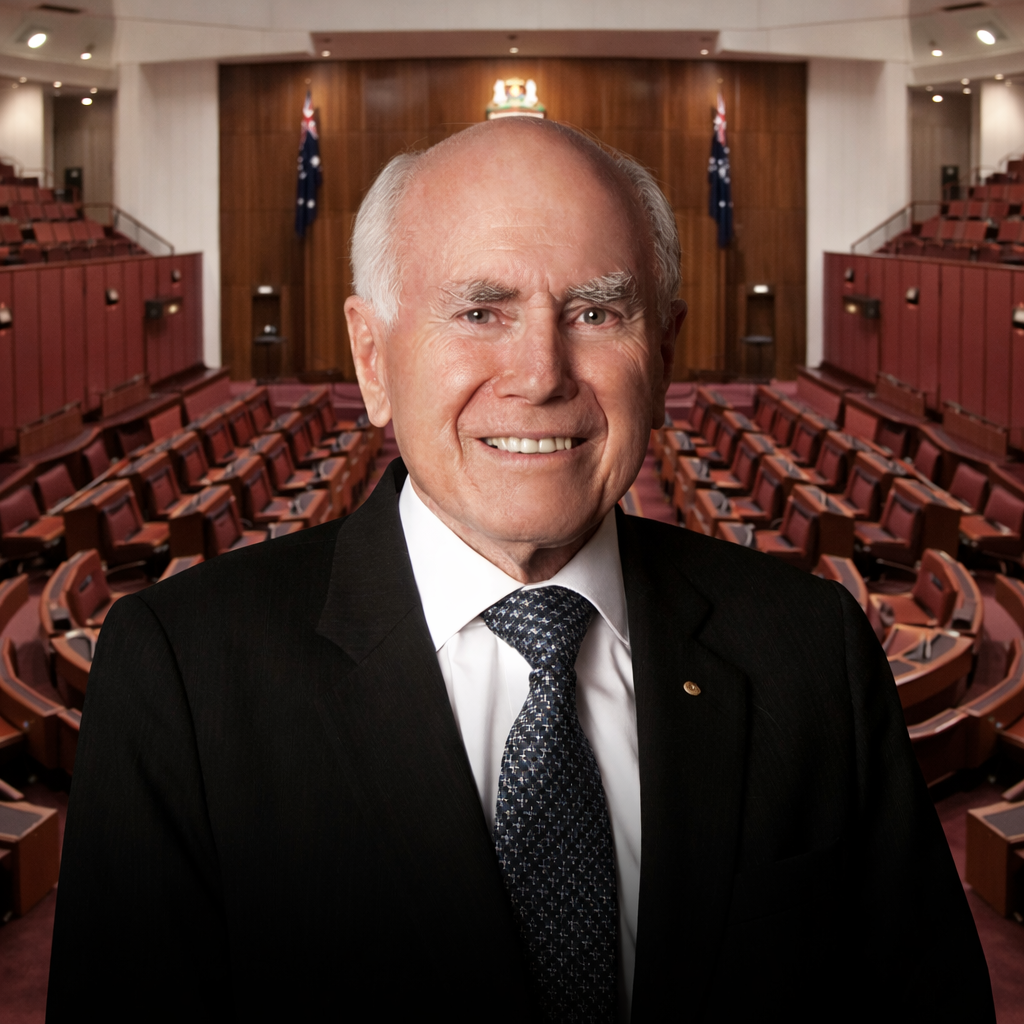
John Howard served as Australia’s prime minister from 1996 to 2007, leading the Liberal Party of Australia to four consecutive election victories and becoming the nation’s second longest serving prime minister. He came to office after defeating Paul Keating in a campaign that focused heavily on economic management, interest rates and a promise to represent what he called the “mainstream” of Australian society. Early in his tenure, Howard moved quickly to reshape fiscal policy and the structure of government revenue. The introduction of the Goods and Services Tax in 2000 was one of the most significant reforms of his era, fundamentally altering the tax system and strengthening the revenue base of the states. His government also oversaw the partial privatisation of Telstra and implemented sweeping national gun law reforms following the Port Arthur massacre in 1996, measures that received broad public support. Throughout the late 1990s and early 2000s, Australia experienced sustained economic growth, falling unemployment and consistent budget surpluses, trends that Howard and his treasurer Peter Costello presented as evidence of disciplined financial stewardship and structural reform.
Foreign policy and national security became defining elements of Howard’s leadership, particularly after the September 11 attacks in 2001. He invoked the ANZUS treaty in support of the United States, committing Australian forces to military operations in Afghanistan and later Iraq, and forged a close relationship with US president George W. Bush. Howard argued that these decisions were necessary to uphold alliance commitments and combat global terrorism, while critics questioned the intelligence underpinning the Iraq War and the long term strategic consequences. At the same time, his government sought to deepen engagement with Asia, expanding trade ties with China and managing delicate diplomatic relationships in the region, including with Indonesia after the East Timor intervention in 1999. Border protection policies became central to his political identity, especially during the 2001 Tampa affair. Measures such as offshore processing and the Pacific Solution were introduced to deter unauthorised boat arrivals, reshaping the immigration debate and contributing to his re election campaign that year, which was fought heavily on themes of security, sovereignty and national control.
Domestically, Howard emphasised social conservatism, a strong national identity and significant industrial relations reform. His government promoted policies designed to increase labour market flexibility, culminating in the WorkChoices legislation of 2005. While supporters argued that the reforms improved productivity and simplified workplace agreements, opponents contended that they weakened worker protections and eroded collective bargaining rights. The backlash against WorkChoices became a central factor in the 2007 election campaign. Howard’s record on Indigenous affairs also generated sustained debate. His government declined to offer a formal apology to the Stolen Generations during his time in office and instead focused on practical reconciliation, later launching the Northern Territory Intervention in response to reports of child abuse in remote communities. After more than eleven years in power, Howard’s government was defeated by the Australian Labor Party under Kevin Rudd, and Howard himself lost his seat of Bennelong, marking a rare outcome for a sitting prime minister. His time in office remains one of the most consequential and debated periods in modern Australian political history.
Discover more from The Oceanic Press
Subscribe to get the latest posts sent to your email.